
Starfleet Almost Built a Slave Race. Data's Trial Didn't Stop It.
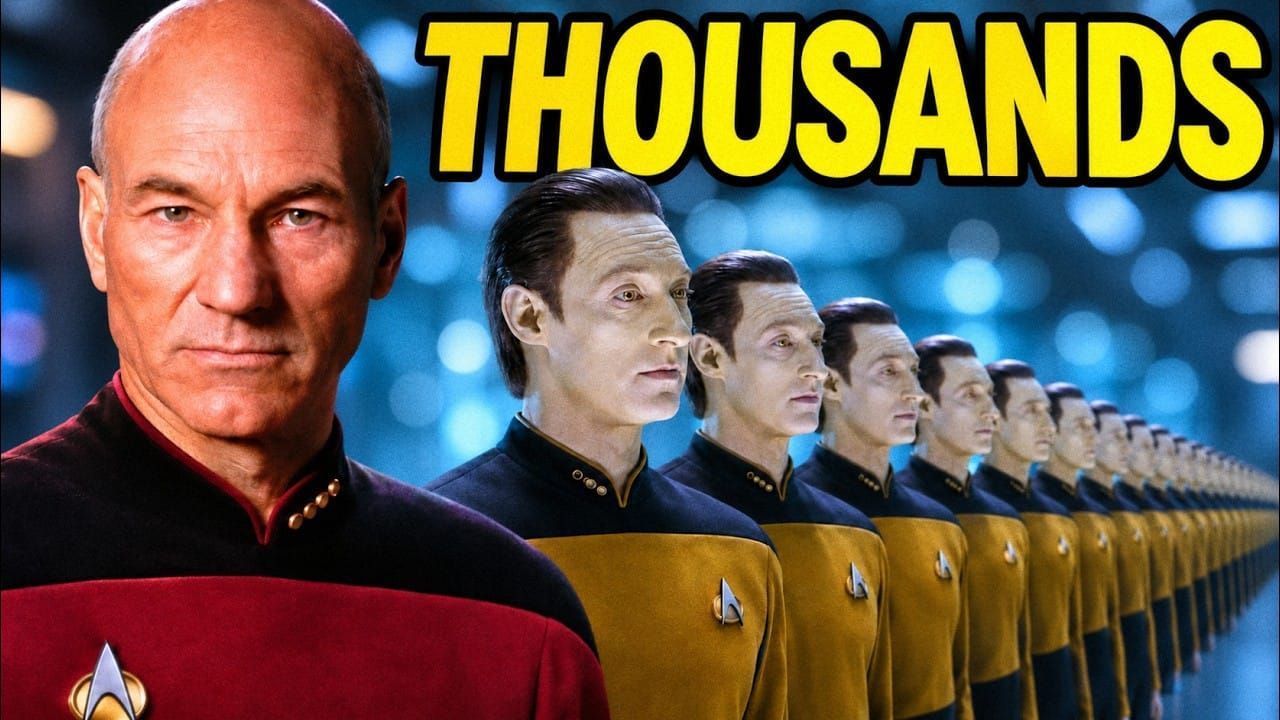
Summary of findings
Picard won Data's freedom in TNG's The Measure of a Man without proving he was conscious. The ruling never covered Lal, the exocomps or the synths on Mars in Star Trek: Picard, and Maddox's argument is the same one we're having about AI now.
Picard won Data his freedom in The Measure of a Man, and if you listen closely, nobody in that room ever answers the question Data asks. Picard never proved Data was alive. He made sure nobody could prove he wasn't. This file goes back into that courtroom, then follows the ruling forward to see who it actually protected.
"Your android"
An admiral tours a brand new starbase and mentions, on his way off the bridge, that Commander Maddox is here to work on "your android." Hold on to that, because how people talk about Data matters a lot in this story. Maddox was the one member of Data's Academy committee who voted against him, and now he wants to take Data apart. He shows up with the transfer orders already in hand.
The best argument against Data
Maddox deserves a real hearing. The Enterprise computer talks, reasons and runs the ship, and nobody thinks it gets to turn down an upgrade. His point is that the only reason anyone's upset is that Data has a face. It's the best argument anyone makes against Data, and it never really gets answered.
Captain Phillipa Louvois of the JAG office finds a law, the Acts of Cumberland, and rules Data is Starfleet property. Picard forces a hearing, and with no staff on the base, the prosecution falls to Riker. If he refuses, she rules Data a toaster with no hearing at all.
The episode never says what the Acts of Cumberland actually contain, only that they were passed in the early 21st century, which is roughly now. So we won't pretend to know what's in them.
The off switch
Riker does his job, and he does it really well. He has Data bend a steel bar, walks through who built him, and then finds the off switch. "Pinocchio is broken. Its strings have been cut." Nobody says a word.
At the recess, Guinan doesn't argue about whether Data is conscious. She asks what happens if Maddox wins: an army of Datas, all disposable. Picard names it himself. Slavery, hidden behind a comfortable word, property.
"I don't know. Do you?"
Picard comes back with a different case. Riker proved Data is a machine, and Picard's answer is "So are we." Then he turns Maddox's three tests (intelligence, self-awareness, consciousness) back on Maddox, and Maddox can't run them on Picard either.
The ruling covered Data, and that's about it
About a year later, Data builds Lal. Out in the corridor, Picard's first words are "It's not a child. It's an invention." He comes around fast, but the argument he grabbed first is basically Riker's steel bar. When Admiral Haftel orders Lal into Starfleet Research, Picard refuses: "Order a man to hand his child over to the state? Not while I am his captain." The ruling gave Data a choice. It said nothing about anyone Data might make.
Then it's Data's turn. In The Quality of Life, he locks out the transporter rather than send the exocomps to die. Nobody fought for them except Data, because he'd been through it himself.
Right now
In June 2022, a Google engineer said the company's LaMDA chatbot was sentient. Google put him on leave and fired him the next month, and a lot of scientists called LaMDA a complex algorithm built to produce convincing language. That's Picard's question showing up in the real world, and it ran into the same wall Maddox did.
Maddox's refit question is still the fair objection. If you can't switch something off until you prove it isn't conscious, what about the Enterprise computer? Picard never had to answer that, because his client had a face. We feel more for things that look and talk like us, and I'm not sure that tells us much about the machine.
Picard couldn't prove Data was conscious. Could you prove an AI isn't? Tell me below.